Top>
Developed Codes> ACE-3D
Three-dimensional two-fluid model analysis code ACE-3D
ACE-3D is a calculation program that predicts the behavior of gas-liquid two-phase flow, which is a mixed flow of gas and liquid, using computational fluid dynamics. Gas-liquid two-phase flow appears in many engineering fields, including nuclear plants, power plants, and chemical plants where heat extraction and gas-liquid reactions are important. ACE-3D was developed to efficiently compute larger systems than TPFIT. For this reason, ACE-3D does not directly resolve the gas-liquid interface. Instead, interface-related phenomena are represented using model correlations and a physical quantity called void fraction*. Compared with TPFIT, ACE-3D has a more limited applicable range, but it has the advantage of requiring less large-scale computing resources.
*Void fraction: The ratio of gas volume to the total volume in a fluid region. A value of 1 means gas only, and 0 means liquid only. Strictly speaking, this is a statistically averaged value.
*Void fraction: The ratio of gas volume to the total volume in a fluid region. A value of 1 means gas only, and 0 means liquid only. Strictly speaking, this is a statistically averaged value.
Features: Features
Adoption of 3D two-fluid model
One of the characteristics of two-phase flow is that gas and liquid can have different velocities. In the three-dimensional two-fluid model, different equations are solved for gas and liquid velocities, allowing direct treatment of this velocity difference. Compared with methods that neglect or simplify phase velocity differences, this approach can be applied to a wider range of conditions. On the other hand, the number of governing equations increases and computation becomes more expensive. ACE-3D addresses this issue by applying parallel computation techniques and enables practical simulations with realistic computation time.
Compatible with supercritical pressure fluids
ACE-3D incorporates a dedicated algorithm to handle not only two-phase flow but also supercritical-pressure fluids, which are often treated as single-phase flow. Therefore, transitions from supercritical flow to two-phase flow due to pressure decrease, and the reverse transitions, can be computed seamlessly.
Compatible with various calculation conditions
ACE-3D supports analysis under a wide range of conditions by allowing flexible boundary conditions without modifying source code. Gravitational acceleration can also be changed arbitrarily, which enables simulations under vibration conditions such as earthquakes.
Analysis examples: Examples
Air-water two-phase flow in a circular pipe
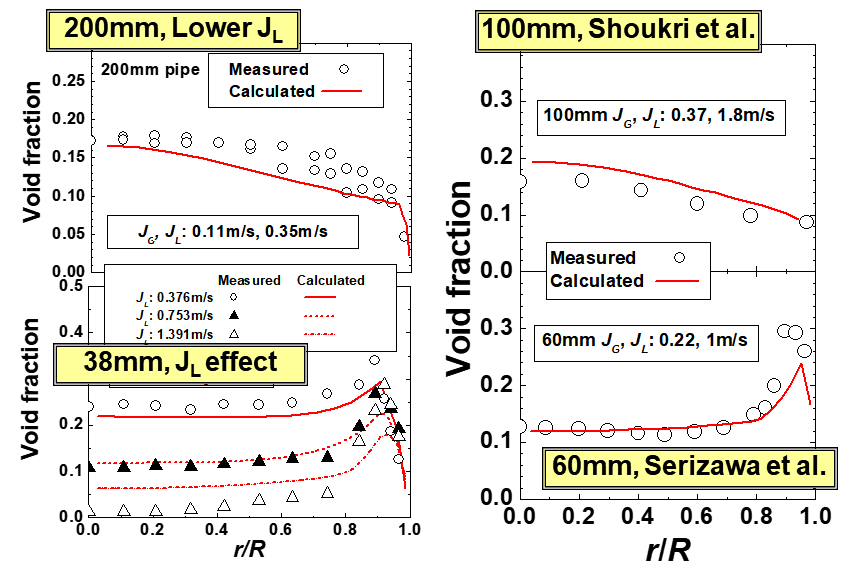
We calculated the void fraction distribution in a circular pipe when an air-water two-phase flow is supplied. It is known that the void fraction distribution changes with air/water flow rates and pipe diameter, and ACE-3D can reproduce these experimentally observed trends.
Flow behind a cylinder in two-phase flow
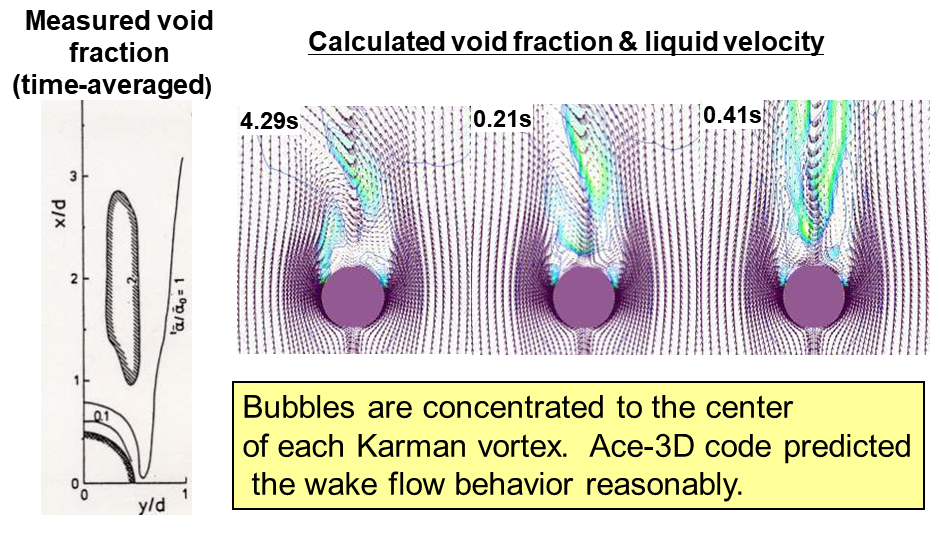
This case shows water flow containing many small bubbles past a cylinder. A vortex forms behind the cylinder, and bubbles gather near the vortex center. ACE-3D results agree well with experimental observations.
Two-phase flow in a fuel assembly
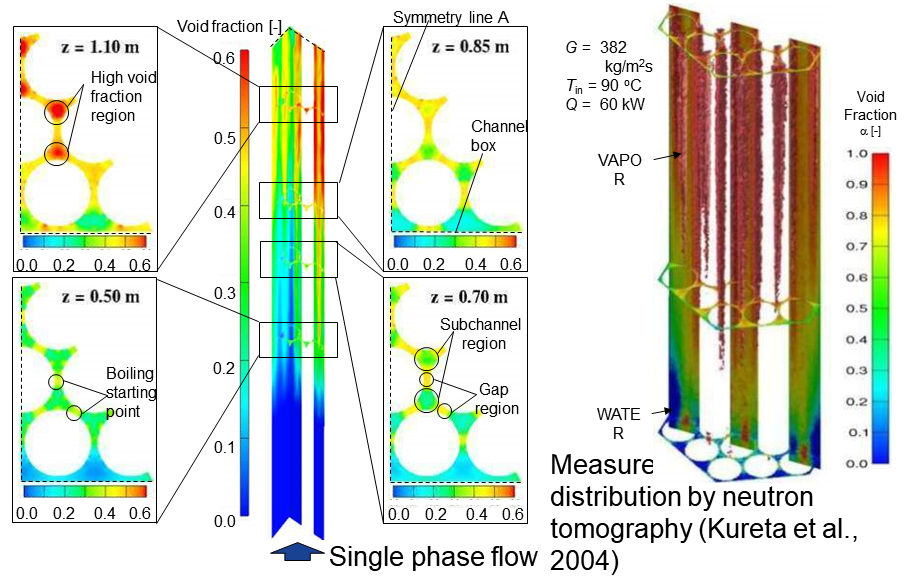
We simulated two-phase flow generated in a fuel assembly by water boiling. Because the flow goes upward, boiling starts in the lower part and the void fraction (steam amount) gradually increases toward the upper part. Boiling in the lower part occurs between fuel rods, while in the upper part steam migrates toward wider spaces in the assembly. ACE-3D results are qualitatively consistent with experiments.
Analysis of heat transfer test using supercritical-pressure water
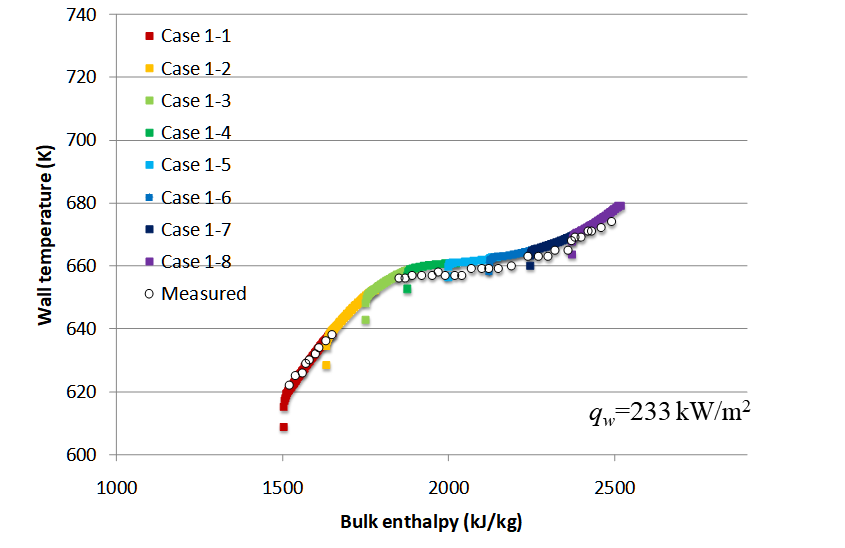
We performed analysis corresponding to an experiment using supercritical-pressure water. The wall temperature computed by ACE-3D agrees well with measured wall temperature, confirming that ACE-3D can predict heat transfer behavior in supercritical-pressure water.
Usage
The ACE-3D code is a computational code related to nuclear technology, and therefore it is not provided for direct download from this website. Under the agreement of the core development organizations Japan Atomic Energy Agency (JAEA), High Energy Accelerator Research Organization (KEK), and Research Organization for Information Science and Technology (RIST), this code is designated as a program that can be provided for use outside JAEA. Please search for it through the Nuclear Code Center (https://www.rist.or.jp/nucis/) and then apply for use. A handling fee is required (13,420 JPY including tax per code). In addition, the ACE-3D license is valid only for an individual user, so each user must obtain their own license.