Top>
Developed Codes> TPFIT
Detailed two-phase flow analysis code TPFIT
TPFIT is a calculation program that can predict the behavior of "gas-liquid two-phase flow," which is a mixed flow of gas and liquid, in detail and with high accuracy. gas liquid
Two-phase flow, including nuclear
This process is widely used in power plants, chemical plants, and other situations where heat is extracted or gases and liquids react. Prediction of gas-liquid two-phase flow is important for economical and
Although this is desired from the perspective of improving totality, since there is a "(gas-liquid) interface" between gas and liquid, which is a characteristic of gas-liquid two-phase flow,
Compared to ``single-phase flow,'' which is a flow of only the body, there are many problems in calculating it.
TPFIT uses a method called the "improved interface tracking method" originally developed by the Japan Atomic Energy Agency, which allows calculations to include movement and deformation of the interface.
I'm playing Noh.
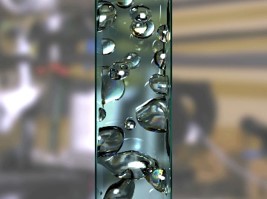
Features: Features
Adoption of improved interface tracking method
When calculating two-phase flows where the interface is greatly deformed or moves at high speed, many analysis programs cause large analysis errors due to the influence of numerical diffusion at the interface.
Alternatively, numerical diffusion at the interface is suppressed by non-physical and artificial methods. The improved interface tracking method adopted by TPFIT uses numerical diffusion
In principle, eliminate the influence of
This enables highly accurate analysis without using non-physical and artificial methods. In addition, in analysis programs that handle the movement and deformation of many interfaces, liquid
We are calculating the movement of the volume fraction of the body, but the improved interface tracking method calculates the movement of mass of gas and liquid, so we are calculating the “pressure
It can also be easily applied to compressible fluids.
Support for highly parallel computing
TPFIT does not use libraries that depend on hardware or compilers, so it is compatible with Windows, macOS, Linux, etc.
It can be executed in various environments. In addition, it supports parallel computation using MPI and OpenMP, which are the de facto standards for parallel computation.
We have a track record of executing analyzes using more than 1 billion calculation cells in 4,096 parallel processes. This allows two-phase flow in very large systems to be controlled over relatively short periods of time.
You can run it with
high stability
TPFIT has been developed with a focus on calculation stability. For example, a Venturi scrubber, which is a decontamination device that uses two-phase flow, has several tens of
A high-speed two-phase flow of m/s to several hundred m/s appears. TPFIT has a track record of analyzing the movement and deformation of small droplets in flow.
I will.
Support for real-time visualization
Especially when you start using an analysis code or start calculations under new conditions, it is important to check the progress of the calculations as the analysis progresses.
It is effective in doing so. TPFIT uses a unique visualization processing unit to enable real-time visualization.
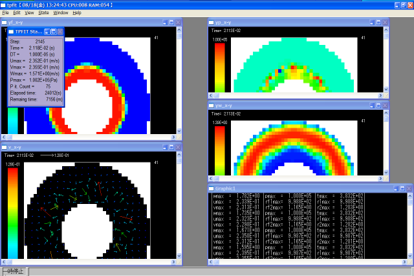
Support for various calculation conditions
TPFIT supports analysis under various conditions, so boundary conditions with a high degree of freedom can be specified without modifying the code. For example,
Conditions supported include value replacement, changes according to the SIN function or linear function, input from a list, etc. Also, the gravitational acceleration can be set arbitrarily.
Since it can be changed to , it is also compatible with calculations when vibrations such as earthquakes are applied.
Specifications: Specifications

Analysis examples: Examples
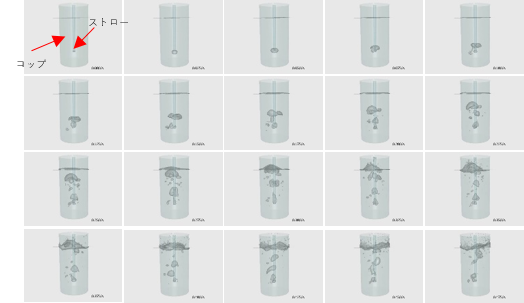
Blow air into the glass of water with a straw
When you blow air through a straw, bubbles will form inside the cup. The bubbles then move toward the water surface. The water surface rises due to bubbles being blown in, and the bubbles that reach the water surface fly away.
You can see that the appearance of water scattering as small droplets when taken out is reproduced.
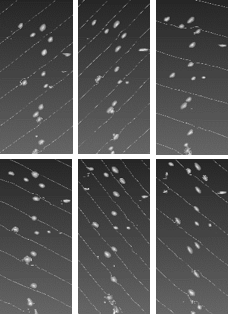
Motion of bubbles in a vibrating container
Analysis when air is injected from a nozzle into water in a rectangular parallelepiped container measuring 200 mm wide, 250 mm high, and 168 mm deep, and vibrations of 1 g and 10 Hz are applied in the lateral direction. The vibration is horizontal
The gravitational acceleration in the direction is given by changing it according to the SIN function.
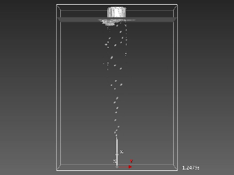
The figure below shows the details, and the white line represents the pressure isovalue line. We solved the conclusion, which is difficult to obtain experimentally, that the direction of the pressure isovalue line and the long axis of the bubble are almost the same.
I was able to obtain it through analysis.
Usage
The TPFIT code is a computational code related to nuclear technology, and therefore it is not provided for direct download from this website. Under the agreement of the core development organizations Japan Atomic Energy Agency (JAEA), High Energy Accelerator Research Organization (KEK), and Research Organization for Information Science and Technology (RIST), this code is designated as a program that can be provided for use outside JAEA. Please search for it through the Nuclear Code Center (https://www.rist.or.jp/nucis/) and then apply for use. A handling fee is required (13,420 JPY including tax per code). In addition, the TPFIT license is valid only for an individual user, so each user must obtain their own license.