Top>Research and Development>Development of conserved Ghost Fluid Method for compressible gas-liquid two-phase flow
Development of conserved Ghost Fluid Method for compressible gas-liquid two-phase flow
In numerical analysis of compressible gas-liquid two-phase flows, it is important to appropriately handle discontinuities in physical quantities at interfaces. The Ghost Fluid Method (GFM) is widely used as a method that can maintain a sharp interface while suppressing numerical diffusion by introducing a virtual fluid (ghost fluid) near the interface. However, conventional GFM has the problem of compromising the conservation of mass, momentum, and energy due to the assumption that the calculation cell is treated as a single fluid.
In this study, to solve this problem, we proposed a conserved Ghost Fluid Method with Interface Cell (CGFM-IC) that incorporates the VOF (Volume of Fluid) method. This method introduces an "interface cell" in which gas and liquid phases coexist, and updates the stored amount using a common flux on each cell surface to ensure strict storage.
Furthermore, by using ghost fluid for flux calculations near the interface, similar to conventional GFM, numerical diffusion is suppressed while maintaining the discontinuity of the interface. In addition, the PLIC-VOF method is used to capture the interface, and by geometrically reconstructing the interface position, highly accurate interface tracking is achieved.
As a numerical method, we apply the finite volume method to the conservative governing equation, and by combining it with a Riemann solver using the HLLC method and MUSCL reconstruction, we can also handle compressible flows including shock waves. In addition, by switching the time integration method near the interface and in the bulk region, we aim to achieve both stability and computational efficiency.
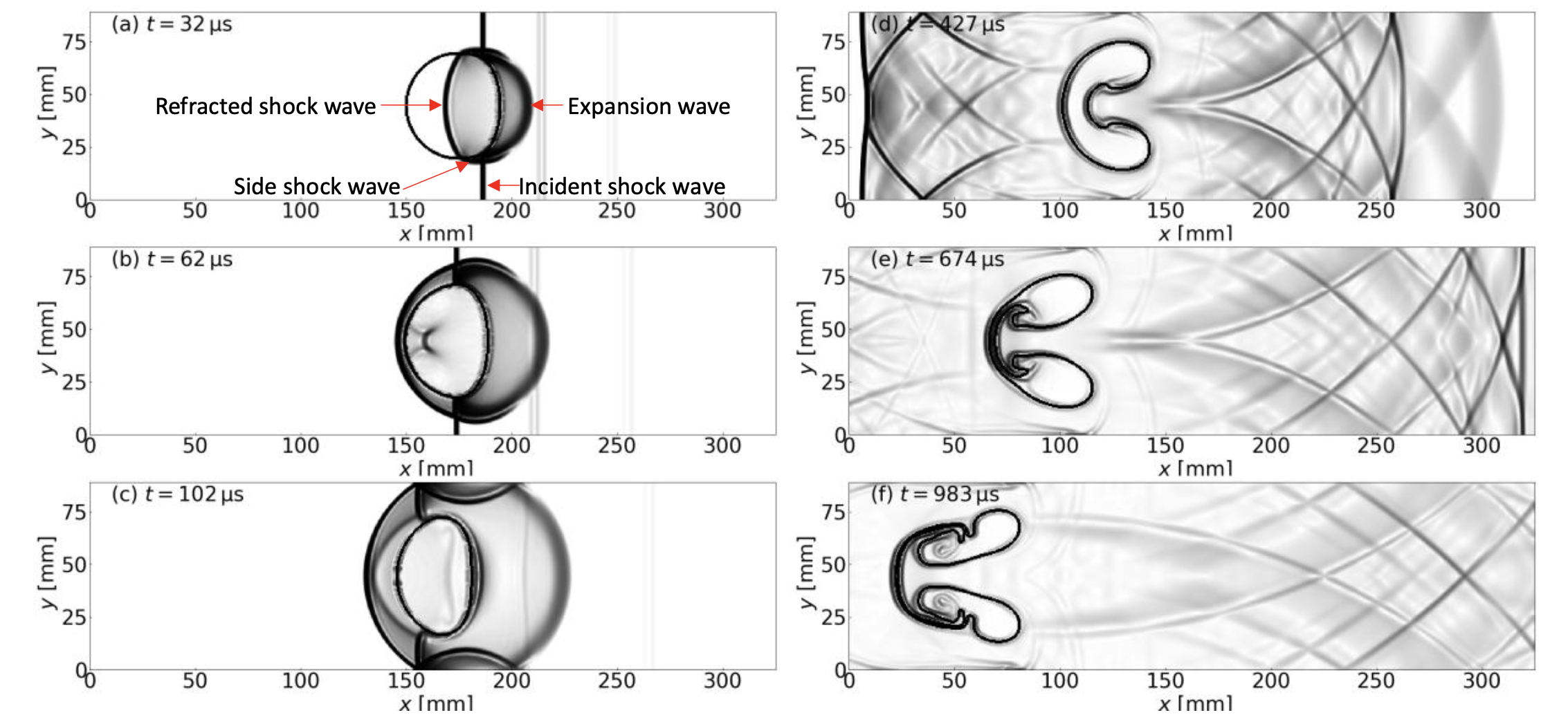
Through verification using one-dimensional and two-dimensional benchmark problems, we confirmed that this method can maintain interface sharpness while significantly improving storage stability compared to conventional GFM. This provides an effective numerical basis for highly accurate analysis of complex compressible two-phase flow phenomena such as steam explosions.
This research contributes to improving the reliability of compressible multiphase flow analysis by achieving both the two important requirements of preservation and sharp interfaces.
In this study, to solve this problem, we proposed a conserved Ghost Fluid Method with Interface Cell (CGFM-IC) that incorporates the VOF (Volume of Fluid) method. This method introduces an "interface cell" in which gas and liquid phases coexist, and updates the stored amount using a common flux on each cell surface to ensure strict storage.
Furthermore, by using ghost fluid for flux calculations near the interface, similar to conventional GFM, numerical diffusion is suppressed while maintaining the discontinuity of the interface. In addition, the PLIC-VOF method is used to capture the interface, and by geometrically reconstructing the interface position, highly accurate interface tracking is achieved.
As a numerical method, we apply the finite volume method to the conservative governing equation, and by combining it with a Riemann solver using the HLLC method and MUSCL reconstruction, we can also handle compressible flows including shock waves. In addition, by switching the time integration method near the interface and in the bulk region, we aim to achieve both stability and computational efficiency.
Through verification using one-dimensional and two-dimensional benchmark problems, we confirmed that this method can maintain interface sharpness while significantly improving storage stability compared to conventional GFM. This provides an effective numerical basis for highly accurate analysis of complex compressible two-phase flow phenomena such as steam explosions.
This research contributes to improving the reliability of compressible multiphase flow analysis by achieving both the two important requirements of preservation and sharp interfaces.
Conceptual diagram of interfacial cell and ghost fluid in CGFM-IC method
reference:Kamiya, T. & Yoshida, H., Conservative ghost fluid method with an interface cell for compressible two-phase fluid simulations, Physics of Fluids 37, 103359 (2025)