Top>Research and Development>Development of a simple boiling model for large-scale boiling flow calculations
Development of a simple boiling model for large-scale boiling flow calculations
Detailed numerical analysis based on the VOF method, which allows direct tracking of the gas-liquid interface, is effective for highly accurate evaluation of boiling two-phase flow in nuclear reactor fuel assemblies. However, in order to directly reproduce the initial boiling process, extremely fine computational grids on the order of several micrometers are required, and application to large-scale systems is impractical from the viewpoint of computational costs.
In this study, we developed a simplified boiling model (SBM) to enable analysis of large-scale boiling flow fields. In SBM, boiling behavior below the lattice scale is modeled by solving the physical model (bubble growth equation and mechanical balance) that governs the bubble growth and separation behavior, and the results are incorporated into the numerical analysis as the heating surface boundary condition (steam blowout).
In addition, by determining the number of bubbles generated based on the heat balance on the heating surface and randomly assigning bubble generation positions, we are able to reproduce non-uniform bubble behavior that is close to the actual boiling phenomenon. This makes it possible to rationally handle bubble behavior over millimeters even with submillimeter-scale grids.
We implemented the developed model into a VOF method-based CFD code (JUPITER) and conducted a numerical analysis of the forced convection boiling field. As a result, the bubble passage period and dependence on flow velocity and heat flux showed good agreement with experimental results, confirming that this model is effective for large-scale boiling flow analysis.
Through this research, we proposed a numerical analysis method that can reproduce the essential behavior of boiling two-phase flow while significantly reducing computational costs.
In this study, we developed a simplified boiling model (SBM) to enable analysis of large-scale boiling flow fields. In SBM, boiling behavior below the lattice scale is modeled by solving the physical model (bubble growth equation and mechanical balance) that governs the bubble growth and separation behavior, and the results are incorporated into the numerical analysis as the heating surface boundary condition (steam blowout).
In addition, by determining the number of bubbles generated based on the heat balance on the heating surface and randomly assigning bubble generation positions, we are able to reproduce non-uniform bubble behavior that is close to the actual boiling phenomenon. This makes it possible to rationally handle bubble behavior over millimeters even with submillimeter-scale grids.
We implemented the developed model into a VOF method-based CFD code (JUPITER) and conducted a numerical analysis of the forced convection boiling field. As a result, the bubble passage period and dependence on flow velocity and heat flux showed good agreement with experimental results, confirming that this model is effective for large-scale boiling flow analysis.
Through this research, we proposed a numerical analysis method that can reproduce the essential behavior of boiling two-phase flow while significantly reducing computational costs.
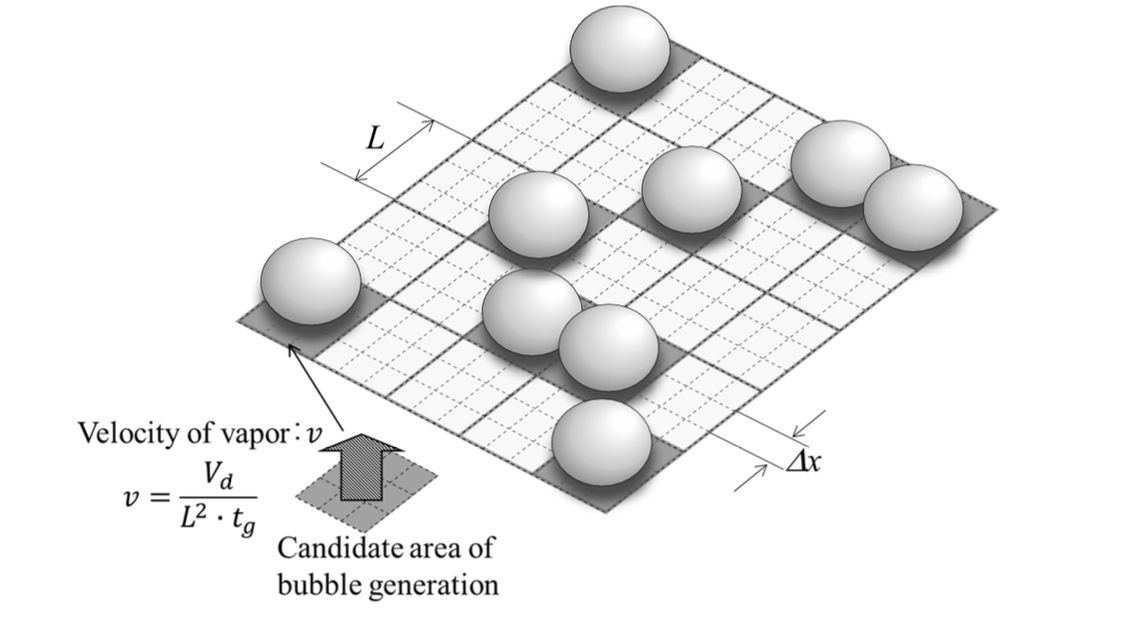
Modeling concept of bubble generation using simple boiling model (SBM)
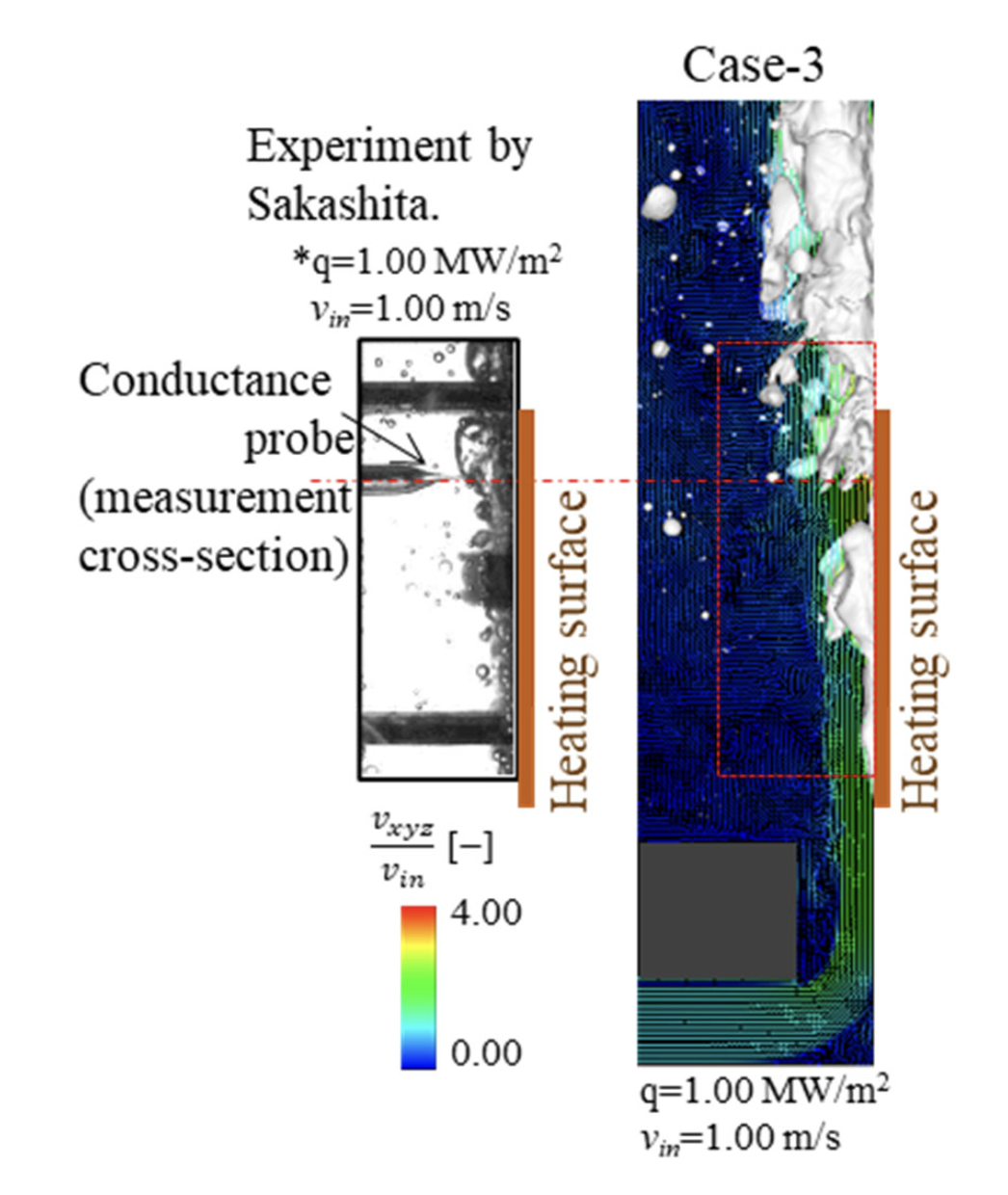
JUPITER simulation when applying the model
reference:Ayako Ono et al. (2024) Development of a simplified boiling model applied for large-scale detailed two-phase flow simulations based on the VOF method, Mechanical Engineering Journal