Top>Research and Development>Elucidation of void rate measurement accuracy using wire mesh sensor
Elucidation of void rate measurement accuracy using wire mesh sensor
The void fraction in gas-liquid two-phase flow is an important physical quantity in the fields of nuclear power and chemical engineering, and wire mesh sensors (WMS) are widely used as a method to measure its spatial distribution with high temporal and spatial resolution. However, it is known that voif fraction measurements using WMS contain systematic errors due to non-uniform current distribution and electrical crosstalk.
In this study, we evaluated the measurement accuracy of WMS in detail by combining electrostatic simulation based on electric field analysis and bubble flow analysis using a CFD code (JUPITER). We visualized the current density distribution and current path for single bubbles, dispersed bubble flows, and slug flows, and analyzed the relationship between sensor signals and true void fraction.
The results revealed that WMS signals contain errors due to influences from outside the sensitivity range (crosstalk) and changes in current paths, and that there are limits to quantitative evaluation of instantaneous void fraction. On the other hand, we showed that linear approximation and Maxwell's formula can be applied to the time-averaged voif fraction depending on the flow conditions and sensor position.
Through this research, we systematically organized the measurement characteristics of WMS and its error generation mechanism, and obtained knowledge that will contribute to improving the reliability of two-phase flow measurement data.
In this study, we evaluated the measurement accuracy of WMS in detail by combining electrostatic simulation based on electric field analysis and bubble flow analysis using a CFD code (JUPITER). We visualized the current density distribution and current path for single bubbles, dispersed bubble flows, and slug flows, and analyzed the relationship between sensor signals and true void fraction.
The results revealed that WMS signals contain errors due to influences from outside the sensitivity range (crosstalk) and changes in current paths, and that there are limits to quantitative evaluation of instantaneous void fraction. On the other hand, we showed that linear approximation and Maxwell's formula can be applied to the time-averaged voif fraction depending on the flow conditions and sensor position.
Through this research, we systematically organized the measurement characteristics of WMS and its error generation mechanism, and obtained knowledge that will contribute to improving the reliability of two-phase flow measurement data.
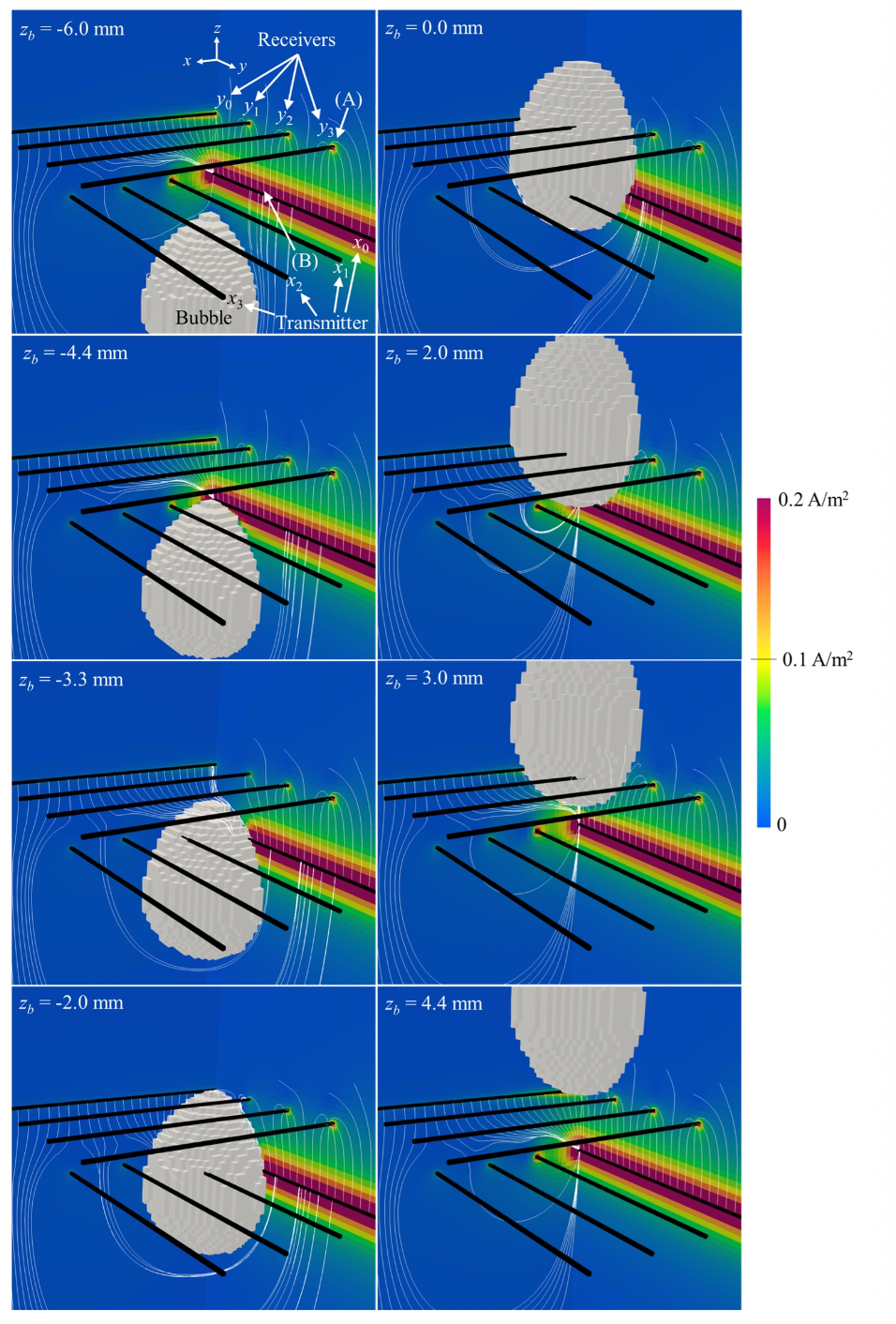
Conceptual diagram of current density distribution and void rate evaluation in wire mesh sensor
reference:Shinichiro Uesawa et al. (2025) Numerical investigation of the accuracy of a conductance-type wire-mesh sensor for a single spherical bubble and bubbly flow, Journal of Nuclear Science and Technology