Top>Research and Development>Heat flow experiment inside debris
Heat flow experiment inside debris
In order to understand the thermal-hydraulic behavior of fuel debris generated in the Fukushima Daiichi Nuclear Power Plant accident, highly accurate data on flow and heat transfer inside porous bodies are required. However, it is difficult to obtain detailed 3D data inside the debris, and there is not enough experimental data to confirm the validity of numerical analysis codes.
In this study, we conducted experiments on flow and natural convection heat transfer in porous bodies with the aim of obtaining high-precision data that will contribute to the verification of numerical analysis codes. Specifically, we measured the pressure drop characteristics and temperature distribution of a porous body consisting of a particle-filled bed, and obtained data from both flow and heat transfer aspects.
As a result, we confirmed that it is possible to evaluate the permeability and Forchheimer coefficient of porous media from the relationship between flow velocity and pressure drop. We also obtained the temperature distribution inside and around the porous body under natural convection conditions, and succeeded in capturing the coupled behavior of flow and heat transfer.
Furthermore, as a result of comparing the acquired experimental data with numerical analysis, it was confirmed that the two generally matched, and differences due to the effects of high flow rate conditions and thermal equilibrium assumptions were also revealed.
Through this research, we established a method for acquiring highly accurate experimental data on heat flow inside porous bodies, and provided basic data that will contribute to fuel debris analysis.
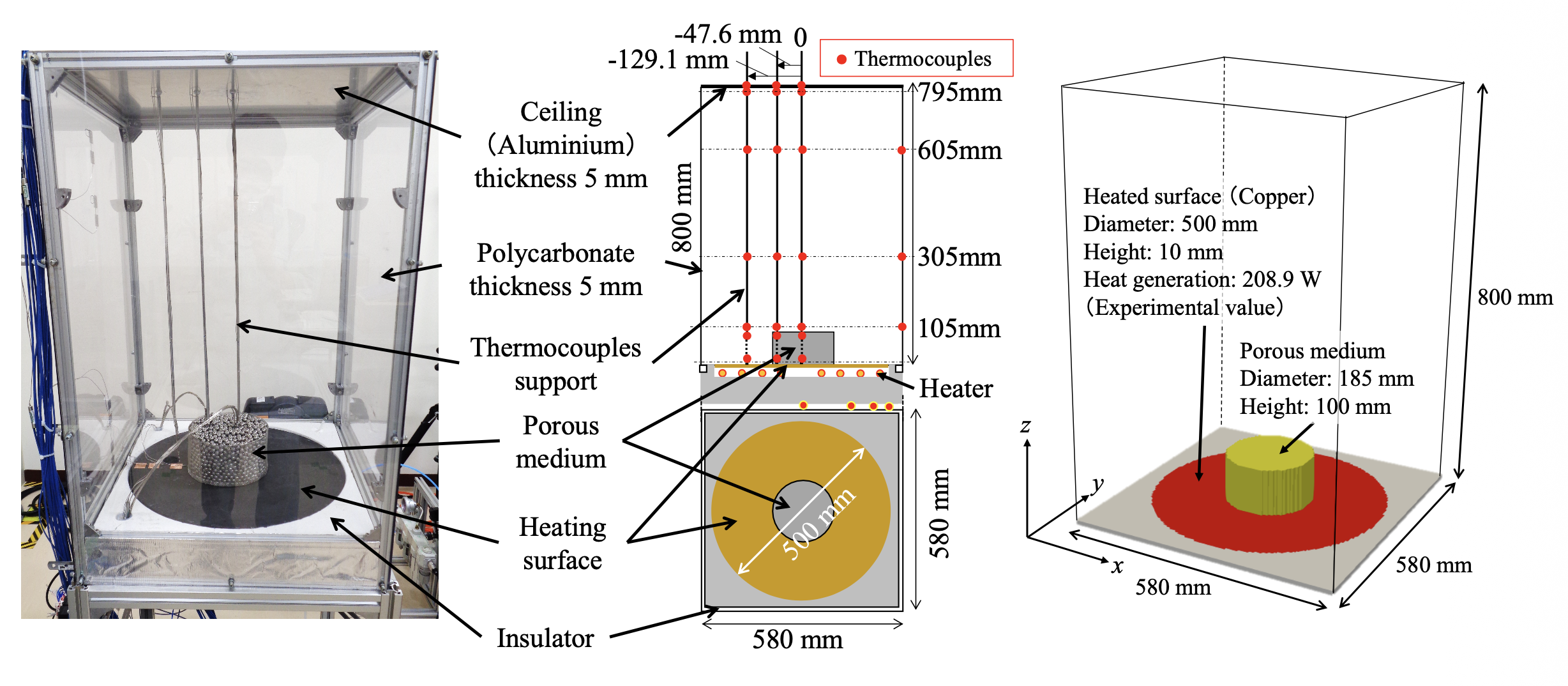
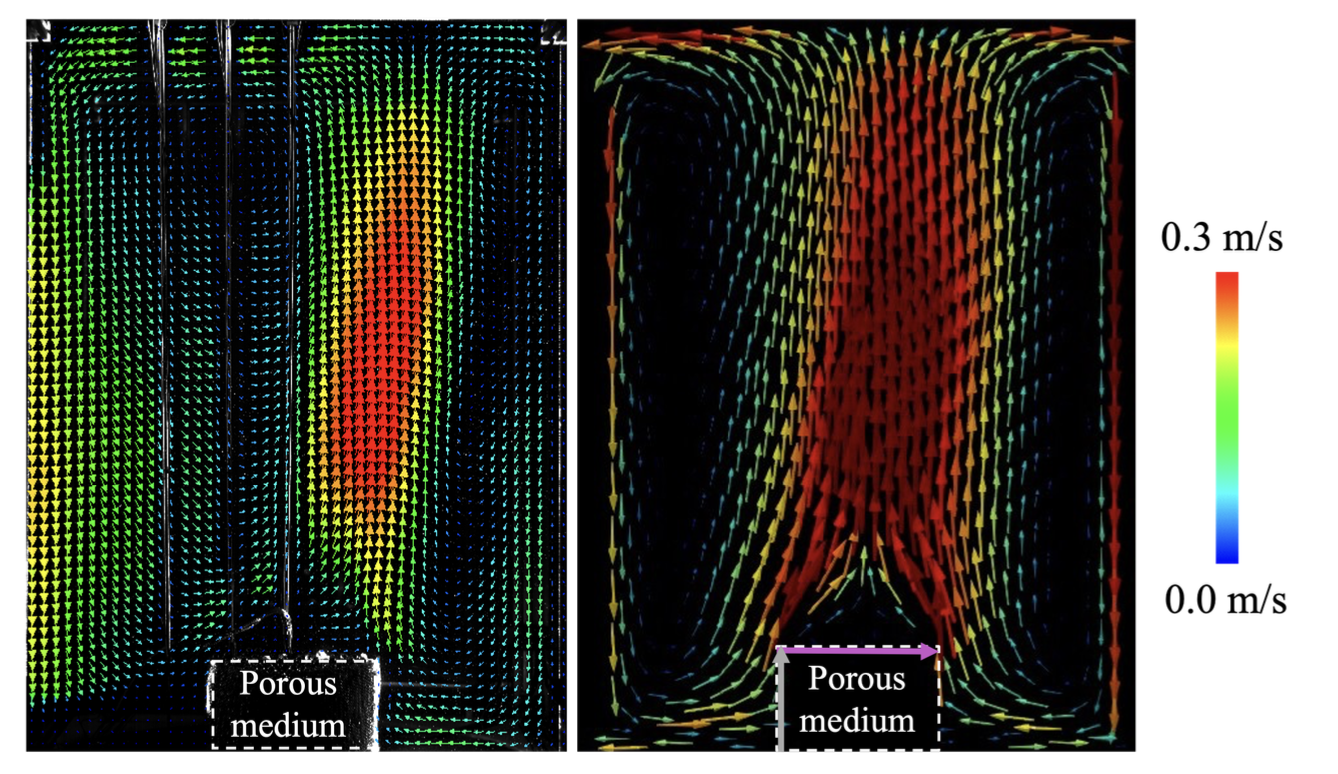
In this study, we conducted experiments on flow and natural convection heat transfer in porous bodies with the aim of obtaining high-precision data that will contribute to the verification of numerical analysis codes. Specifically, we measured the pressure drop characteristics and temperature distribution of a porous body consisting of a particle-filled bed, and obtained data from both flow and heat transfer aspects.
As a result, we confirmed that it is possible to evaluate the permeability and Forchheimer coefficient of porous media from the relationship between flow velocity and pressure drop. We also obtained the temperature distribution inside and around the porous body under natural convection conditions, and succeeded in capturing the coupled behavior of flow and heat transfer.
Furthermore, as a result of comparing the acquired experimental data with numerical analysis, it was confirmed that the two generally matched, and differences due to the effects of high flow rate conditions and thermal equilibrium assumptions were also revealed.
Through this research, we established a method for acquiring highly accurate experimental data on heat flow inside porous bodies, and provided basic data that will contribute to fuel debris analysis.
System of Thermal-hydraulics experiments inside debris
Comparison of velocity fields between intra-debris heat flow experiments and JUPITER simulations
reference:Susumu YAMASHITA, Shinichiro UESAWA, Ayako ONO, Hiroyuki YOSHIDA, Development of a numerical simulation method for air cooling of fuel debris by JUPITER, Mechanical Engineering Journal, 2023, Volume 10, Issue 4, p. 22-00485