Open source detailed Thermal-hydraulics analysis code
Detailed Thermal-hydraulics analysis code JUPITER
JUPITER is a detailed thermo-hydraulic analysis code developed for the purpose of advanced understanding of gas-liquid two-phase flow in nuclear reactors and the transition phenomena of melted materials that occur during severe accidents. It can handle multiphase flows of arbitrary compositions consisting of gas, liquid, and solid phases, and has CUDA implementation in addition to MPI/OpenMP hybrid parallelization, and supports high-fidelity analysis using large-scale grids. It has been released as open source since April 2026.

What is JUPITER?
Various functions available for nuclear system calculations

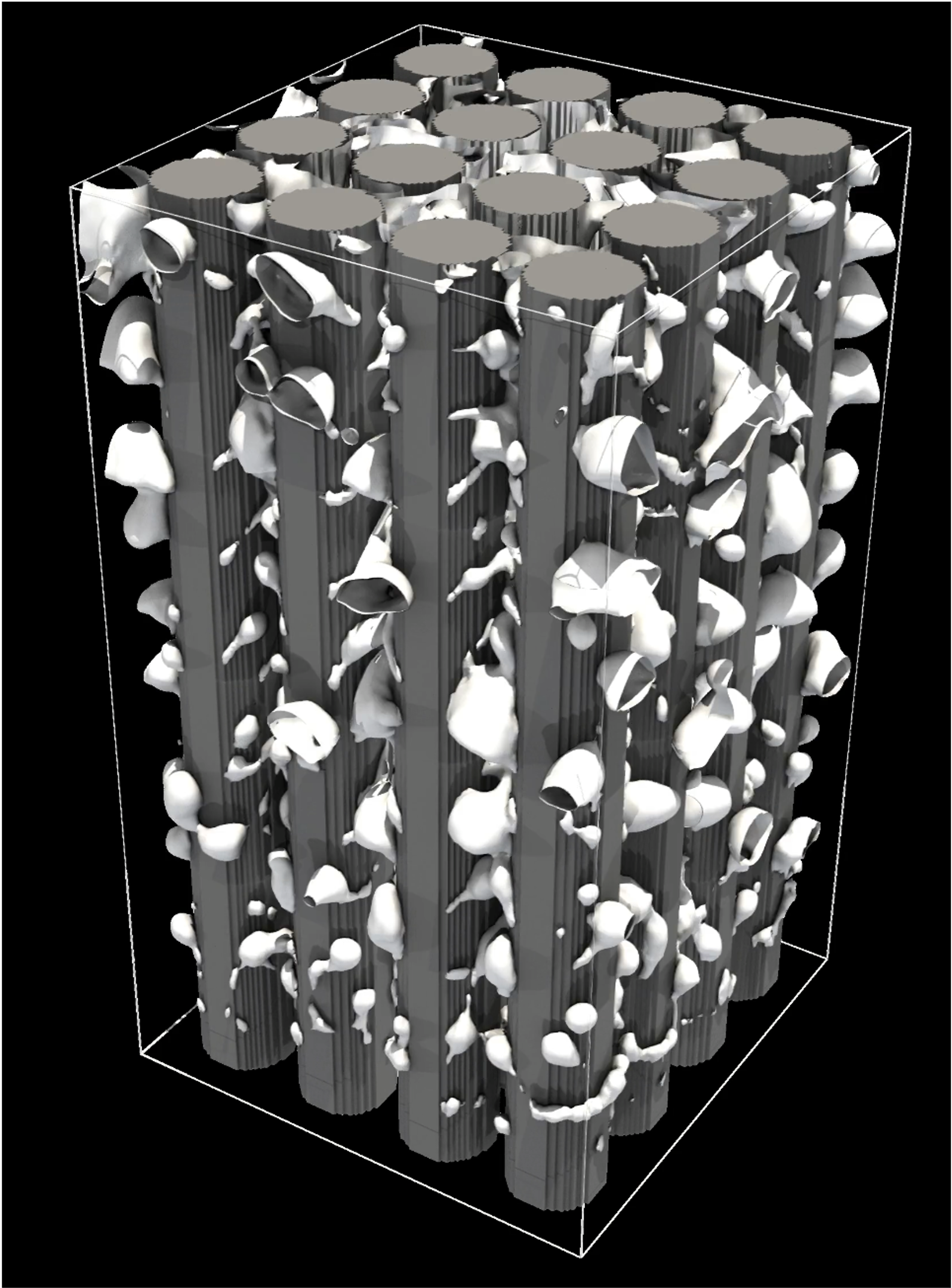
bubbly flow
Gas-liquid two-phase flow containing a large number of bubbles is possible with numerical coalescence of bubbles suppressed.
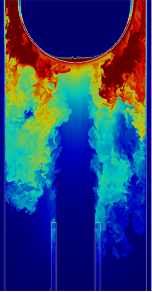
turbulence
If a sufficient number of meshes can be secured, it is also possible to simulate turbulent flow.
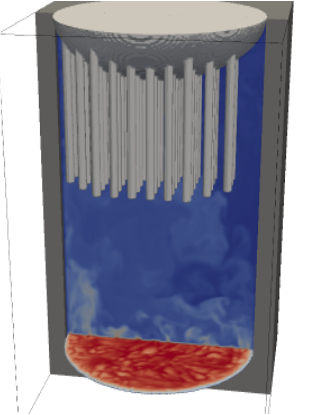
radiation
Detailed evaluation of radiant heat transfer, which is important in thermal analysis of high-temperature melts
eutectic
Evaluating the effects of material interactions and melting point reduction during accidents by considering eutectic reactions
phase change
Simulating melting/solidification, boiling/condensation using temperature recovery method
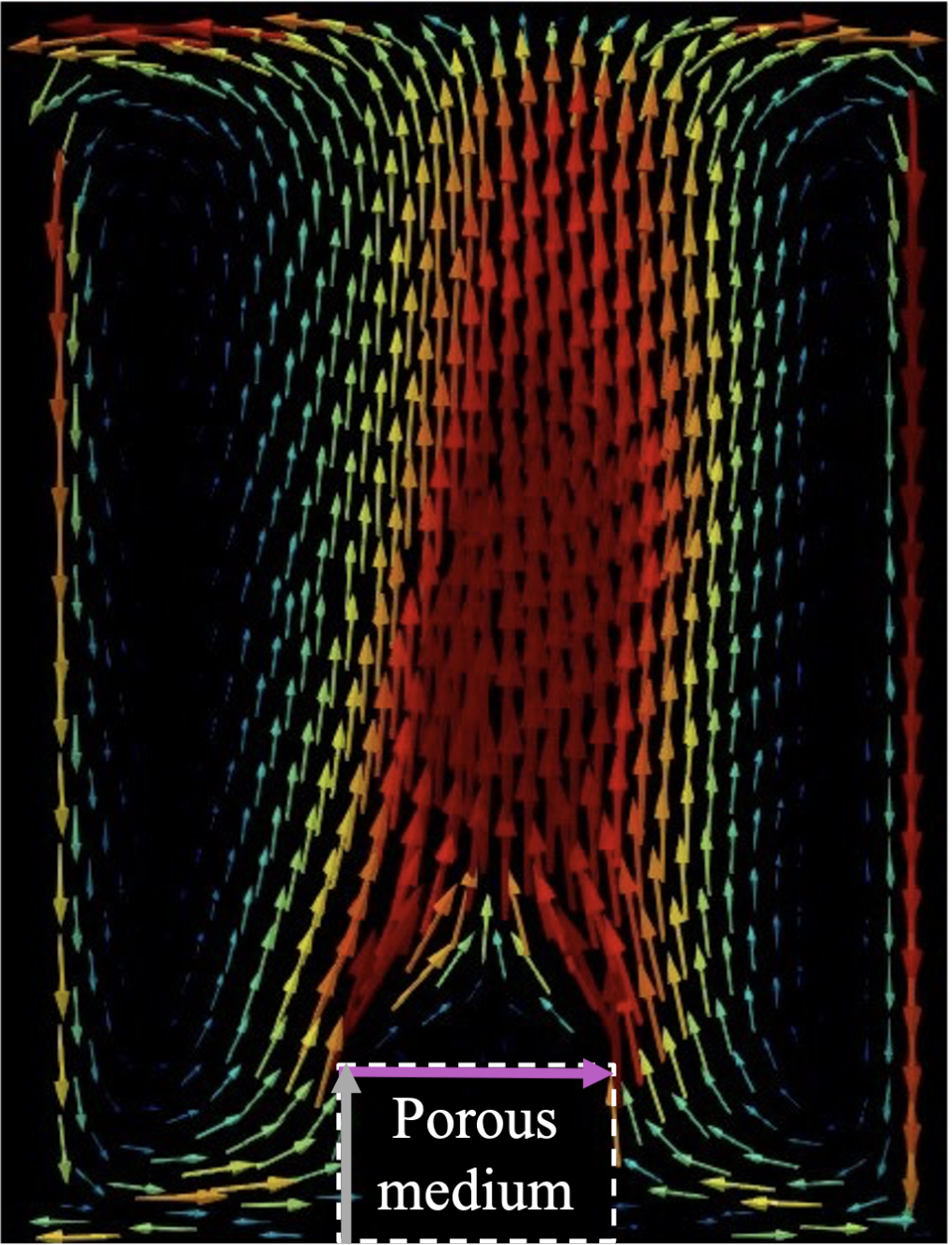
porous flow
Simulating the flow inside a porous body using the Darcy-Brinkman approximation
specs
| Language used | C, Fortran, CUDA | Difference method/lattice | Finite difference method, orthogonal equidistant grid |
|---|---|---|---|
| Operating environment/compiler | LINUX / GNU C, Intel(R) C, PGI(R) C | Shape input | Direct import of 3D-CAD data (STL data) |
| Advection term difference differentiation | 5th WENO method | interface capture | PLIC, THINC, THINC/WLIC, THINC/AWLIC |
| time integral | Third-order accuracy TVD Runge-Kutta method | turbulence model | Model not used (DNS), ILES |
| Parallelization | Massively parallel computing using MPI, OpenMP, and CUDA | Curvature/surface tension calculation method | CLSVOF/CSF model |
| phase change | Temperature recovery method (model under consideration to improve accuracy) | pressure solution | MPI-OpenMP hybrid CG method with preprocessing |
| Additional physical model | Porous flow (Darcy-Brinkman), radiation heat transfer (DO method) | chemical reaction model | Eutectic reaction, steam oxidation, hydrogen absorption reaction |
Usage guide
Public version code download
Download in ZIP format / GitHub public page
Steps to start using (sample calculation)
From building to sample input and visualization, see HERE
manual
Japanese version manual / English version manual
References
S. Yamashita, T. Ina, Y. Idomura and H. Yoshida, “A numerical simulation method for molten material behavior in nuclear reactors,” Nucl. Eng. Des., 332, pp. 301-312 (2017). View paper
inquiry
For inquiries regarding JUPITER, please contact us below.
 fukuda.takanari[at]jaea.go.jp (Takanari Fukuda: change [at] to @)
(Since JUPITER is released as open source, you may be able to obtain clues to problem solving by referring to the source code and manual to the generation AI. Please use these methods as well before contacting us.)
terms of service
BSD-2-Clause
Copyright 2026, Japan Atomic Energy Agency (JAEA) All rights reserved.
Redistribution and use in source and binary forms, with or without modification, are permitted provided that the following conditions are met:
1. Redistributions of source code must retain the above copyright notice,this list of conditions and the following disclaimer.
2. Redistributions in binary form must reproduce the above copyright notice, this list of conditions and the following disclaimer in the documentation and/or other materials provided with the distribution.
THIS SOFTWARE IS PROVIDED BY THE COPYRIGHT HOLDERS AND CONTRIBUTORS "AS IS"
AND ANY EXPRESS OR IMPLIED WARRANTIES, INCLUDING, BUT NOT LIMITED TO, THE
IMPLIED WARRANTIES OF MERCHANTABILITY AND FITNESS FOR A PARTICULAR PURPOSE ARE
DISCLAIMED. IN NO EVENT SHALL THE COPYRIGHT HOLDER OR CONTRIBUTORS BE LIABLE
FOR ANY DIRECT, INDIRECT, INCIDENTAL, SPECIAL, EXEMPLARY, OR CONSEQUENTIAL
DAMAGES (INCLUDING, BUT NOT LIMITED TO, PROCUREMENT OF SUBSTITUTE GOODS OR
SERVICES; LOSS OF USE, DATA, OR PROFITS; OR BUSINESS INTERRUPTION) HOWEVER
CAUSED AND ON ANY THEORY OF LIABILITY, WHETHER IN CONTRACT, STRICT LIABILITY,
OR TORT (INCLUDING NEGLIGENCE OR OTHERWISE) ARISING IN ANY WAY OUT OF THE USE
OF THIS SOFTWARE, EVEN IF ADVISED OF THE POSSIBILITY OF SUCH DAMAGE.